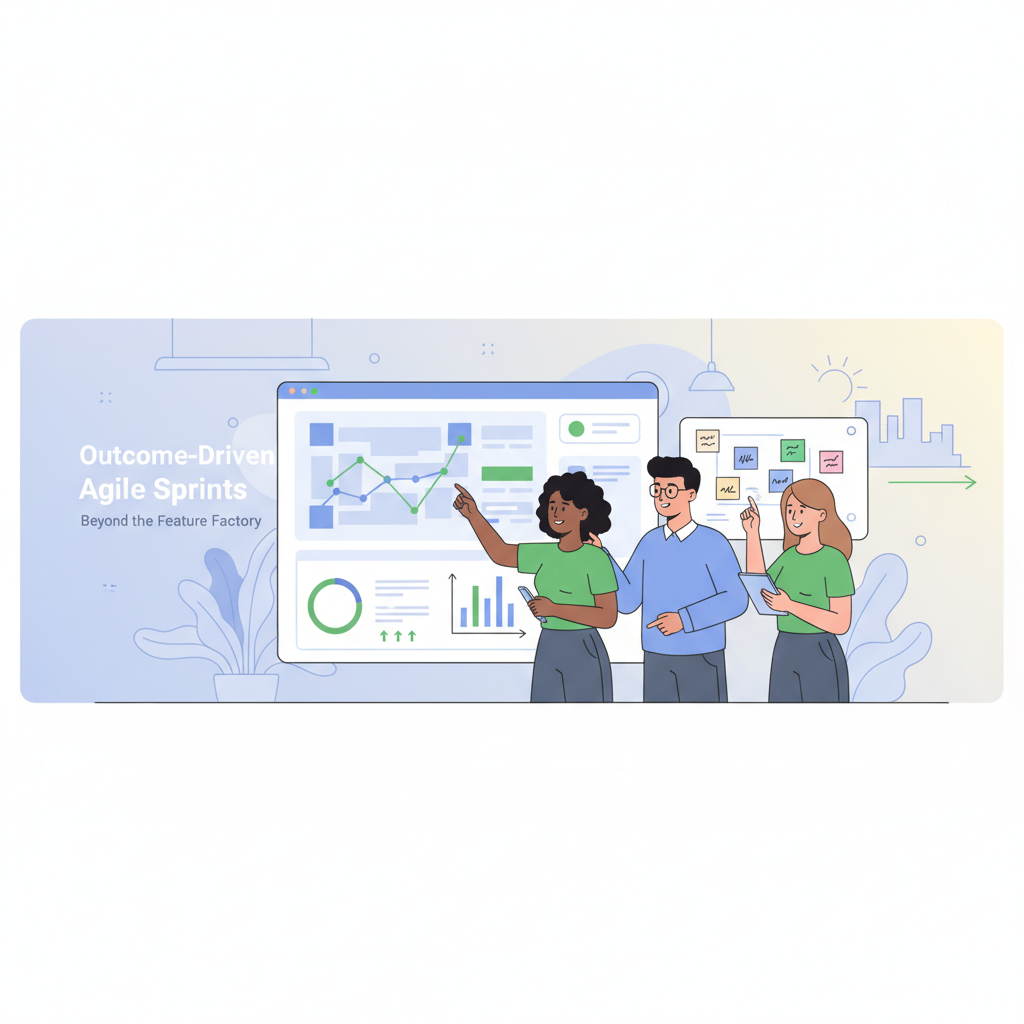
Outcome-Driven Agile Sprints: Beyond the Feature Factory
Tired of shipping features that don't move the needle? Learn how to run outcome-driven sprints to build products that deliver real user and business value.
Product Leader Academy
PM Education
The Sprint Review That Changed Everything
The sprint review is over. Your team is patting themselves on the back. You shipped 17 story points, closed 12 tickets, and demoed three new features. The velocity chart is trending up. By all traditional agile metrics, it was a 'good' sprint.
But a nagging question lingers in your mind as a product leader: Did any of it actually matter?
Did those features solve a real customer problem? Did they move a key business metric? Or did you just spend two weeks getting very good at shipping code that nobody needed?
This is the silent crisis facing many modern product teams. We’ve become so obsessed with the mechanics of agile—the ceremonies, the story points, the velocity—that we've lost sight of the goal. We've optimized for output, not outcome. We've built highly efficient feature factories.
It’s time for a fundamental shift. It's time to embrace Outcome-Driven Agile Sprints. This approach re-centers your team on what truly matters: delivering measurable value to your customers and your business.
Output vs. Outcome: The Crucial Distinction
Before we dive into the 'how', let's establish a crystal-clear understanding of the two concepts at the heart of this shift.
-
Output: This is the 'stuff' you create. It's the tangible, countable result of your team's activity. Outputs are easy to measure but are poor indicators of value.
- Examples: Lines of code written, number of features shipped, story points completed, bugs fixed.
-
Outcome: This is the measurable change in user behavior that results from the stuff you shipped. It's the 'why' behind your work. Outcomes are the bridge between your team's work and business impact.
- Examples: A 15% increase in user retention, a 30-second reduction in average task completion time, a 5% lift in trial-to-paid conversion rate.
Think of it this way: a team building a new diet app could ship a calorie tracker feature (the output). But the desired outcome is for users to log their meals consistently for at least seven days, leading to better health habits and higher engagement.
Focusing on output leads to a culture of 'shipping for shipping's sake'. Focusing on outcomes fosters a culture of learning, problem-solving, and genuine value creation.
| Focus Area | Output-Driven Team (Feature Factory) | Outcome-Driven Team (Value Creator) |
|---|---|---|
| Success Metric | Velocity, story points completed | Change in a key user metric (e.g., activation, retention) |
| Sprint Goal | "Complete tickets X, Y, and Z." | "Reduce user confusion in the checkout flow." |
| Motivation | Meeting deadlines, closing tickets | Solving customer problems, moving the needle |
| Conversation | "Is it done?" | "Did it work? What did we learn?" |
| Risk | Building the wrong thing efficiently | Not learning fast enough |
The Core Components of an Outcome-Driven Sprint
Transitioning to an outcome-driven approach isn't about throwing away your agile framework. It's about upgrading it with a new operating system. Here are the four key components that power this shift.
1. The Outcome-Focused Sprint Goal
This is the single most important change you can make. An output-based sprint goal sounds like a to-do list: "Build the new search filter and ship the date-range picker."
An outcome-focused sprint goal describes the change you want to see in the world. It provides purpose and a clear 'why' for the team.
A simple template to craft your goal:
"This sprint, we aim to [Desired Outcome] for [Target Users] to help them [Achieve a Goal]. We will start by [Key Actions/Features] and we'll know we're on the right track when we see [Measurable Signal]."
Let's see it in action:
- Output Goal: "Ship the new dashboard reporting feature."
- Outcome Goal: "This sprint, we aim to empower project managers to understand team performance without exporting data. We will start by building a 'time-per-task' widget and we'll know we're on the right track when we see a 20% reduction in CSV exports from the dashboard."
This new goal is powerful. It tells the team who they are helping (project managers), what problem they're solving (manual data exporting), and how they'll measure success. It invites creativity beyond just building the prescribed feature.
2. Hypothesis-Driven User Stories
If the sprint goal is your North Star, hypothesis-driven stories are the individual steps you take on that journey. Traditional user stories focus on functionality (As a user, I want X so that I can do Y). They describe a solution but carry a hidden assumption that the solution is the right one.
Hypothesis-driven stories make these assumptions explicit and testable.
The format:
We believe that [building this feature / making this change] for [this persona] will result in [this outcome].
We will know this is true when we see [this measurable evidence].
Example:
- Traditional Story: "As a user, I want to save my credit card details so I can check out faster."
- Hypothesis Story: "We believe that allowing returning customers to save their credit card details will result in a faster, less frustrating checkout experience. We will know this is true when we see a 5% increase in checkout completion rate for returning customers and a measurable decrease in time-to-purchase."
This simple reframing forces you to think about the why behind every single backlog item and how you will validate its impact.
3. Prioritization Based on Impact and Learning
In a feature factory, prioritization is often a battle of stakeholder opinions, HIPPOs (Highest Paid Person's Opinion), or simply what seems easiest to build. In an outcome-driven world, prioritization becomes a strategic exercise in maximizing learning.
The question shifts from "What can we ship in two weeks?" to "What is the smallest and fastest thing we can build to test our most critical hypothesis and learn if we're on the right track to our outcome?"
Frameworks like RICE (Reach, Impact, Confidence, Effort) or ICE become more powerful here. The 'Impact' and 'Confidence' scores are directly tied to your outcome goals and hypotheses. Low-confidence, high-impact ideas might require a smaller experiment first (a 'painted door' test or a concierge MVP) before you commit to building the full feature.
4. Continuous Discovery Throughout the Sprint
Discovery isn't a phase that ends when development begins. An outcome-driven team understands that learning is a constant activity. They bake discovery tasks directly into their sprints alongside development work.
This doesn't mean every engineer becomes a user researcher overnight. It means the whole team is responsible for learning.
Examples of in-sprint discovery tasks:
- Conduct 3 short user interviews to validate the problem behind a future feature.
- Analyze user session recordings (e.g., using FullStory or Hotjar) to understand friction points related to the current sprint goal.
- Launch a one-question survey to a segment of users.
- Collaborate with an engineer to analyze product analytics data and validate an assumption.
By weaving discovery into the sprint, you create a tight feedback loop that ensures you're not just building efficiently, but building the right thing.
Running the Outcome-Driven Sprint: A Practical Guide
Here’s how to adapt your existing agile ceremonies to focus on outcomes.
Sprint Planning
- Start with the Why: As the PM, you don't just show up with a pre-groomed backlog. You start by presenting the desired outcome for the next sprint. Share the customer insights, the data, and the business context that makes this outcome important.
- Collaborate on the Goal: Craft the outcome-focused Sprint Goal with your team. This fosters shared ownership and ensures everyone understands the mission.
- Select Work: Pull in stories that directly contribute to achieving the Sprint Goal. For each one, ask: "How will this help us achieve our outcome? How will we measure its effect?"
Daily Stand-ups
- Frame the Conversation: Go beyond the three standard questions. The new key question is: "How are we progressing towards our Sprint Goal?"
- Focus on Blockers to Learning: A blocker isn't just a technical issue. It could be, "We don't have the analytics tracking in place to measure our hypothesis," or "We need feedback from a user on this prototype before we continue."
Sprint Review
- The Big Show: This is where the outcome-driven approach truly shines. The Sprint Review is no longer just a feature demo. It's a science fair.
- The New Agenda:
- Restate the Goal & Hypothesis: Remind everyone what you set out to achieve and learn.
- Show the Work: Demo the feature(s) you built, explaining how they were designed to influence the outcome.
- Present the Results: This is the climax. Share the data. Did the metric move? What did you learn from analytics? What qualitative feedback did you receive? Be honest about both successes and failures.
- Discuss and Decide: Based on the results, what's next? Do we double down on this path (persevere)? Do we need to adjust our approach (pivot)? Or was our hypothesis wrong, and we should stop investing here?
This transforms stakeholders from passive observers into active participants in the product strategy.
Retrospective
- Level-Up the Questions: In addition to process questions, ask outcome-focused ones:
- "How clear was our Sprint Goal and its connection to our metrics?"
- "Did we have the tools and data we needed to measure our outcome effectively?"
- "How could we have learned whether our idea would work even faster?"
Overcoming Common Challenges
Making this shift isn't always easy. Here are some common hurdles and how to navigate them.
Challenge 1: "My stakeholders demand roadmaps with features and dates."
- The Fix: Don't abandon roadmaps, reframe them. Create an outcome-based roadmap. Instead of listing features for Q3, list the customer or business outcomes you plan to influence (e.g., "Improve New User Activation," "Increase Enterprise Team Collaboration"). You can still list potential features as bets you might place to achieve those outcomes, making it clear that the plan is flexible based on learning.
Challenge 2: "Measuring outcomes within a two-week sprint is impossible."
- The Fix: Differentiate between lagging and leading indicators. While you might not see a change in a big lagging indicator like churn in two weeks, you can measure leading indicators that predict it. These are smaller, faster signals.
- Example: To reduce churn (lagging), you might try to increase feature adoption. Your leading indicator for a sprint could be the percentage of users who successfully use a key new feature three times in their first week.
Challenge 3: "My engineering team just wants to be told what to build."
- The Fix: This is often a symptom of the team being disconnected from the customer and the business. The solution is immersion. Involve your engineers in discovery. Invite them to listen in on customer calls. Share business performance updates. When the team understands the 'why' and feels ownership over the problem, their engagement and creativity will skyrocket. They'll transition from being ticket-takers to problem-solvers.
Your First Step to Becoming an Outcome-Driven Team
Shifting from an output-focused feature factory to an outcome-driven value engine is a journey, not an overnight switch. It requires a change in mindset, language, and process.
But the rewards are immense: a more engaged and empowered team, products that customers actually love and use, and a clear, undeniable link between your team's hard work and the success of the business.
Don't try to change everything at once. Start small.
Your call to action: For your very next sprint planning, try to define just one thing: an outcome-focused sprint goal. Write it on a whiteboard. Talk about it every day. And in your sprint review, focus your discussion on whether you achieved it.
This small step will begin a new conversation—one that moves beyond 'what did we build?' to the only question that truly matters: 'What impact did we have?'
Tags
Related Articles

MoSCoW Prioritization: The Complete Guide for Product Managers
Learn how to use the MoSCoW method to prioritize product features and requirements effectively. Includes examples, templates, and best practices.

RICE Scoring: The Data-Driven Prioritization Framework
Master the RICE scoring model to prioritize features based on Reach, Impact, Confidence, and Effort. Complete guide with calculator and examples.

The Kano Model: Understanding Customer Satisfaction
Deep dive into the Kano Model for categorizing product features based on customer satisfaction. Learn to identify must-haves, delighters, and more.