The Essential Product Manager Frameworks Guide for 2025
A comprehensive guide to the most important product management frameworks. Learn when to use each framework and how to combine them effectively.
Product Leader Academy
PM Education

Why Frameworks Matter
Frameworks are the tools of the product management trade. They provide structured approaches to common challenges, enabling PMs to:
- Make faster decisions with proven mental models
- Communicate clearly using shared vocabulary
- Reduce bias through systematic evaluation
- Build credibility by demonstrating rigor
This guide covers the essential frameworks every PM should master.
Framework Categories
1. Prioritization Frameworks
Purpose: Decide what to build and in what order
| Framework | Best For | Key Strength |
|---|---|---|
| RICE | Quantitative scoring | Data-driven objectivity |
| MoSCoW | Requirements triage | Stakeholder alignment |
| Kano | Customer satisfaction | Emotional impact |
| ICE | Quick scoring | Simplicity |
| Value vs Effort | Fast decisions | Visual clarity |
When to use which:
- RICE: Quarterly roadmap planning with data
- MoSCoW: Sprint planning, scope negotiation
- Kano: New market entry, feature strategy
- ICE: Quick backlog grooming
- Value vs Effort: Rapid prioritization sessions
2. Strategy Frameworks
Purpose: Define direction and positioning
Porter's Five Forces Analyze competitive dynamics:
- Threat of new entrants
- Bargaining power of suppliers
- Bargaining power of buyers
- Threat of substitutes
- Industry rivalry
Jobs to Be Done (JTBD) Understand customer motivations:
- What "job" is the customer hiring your product to do?
- What are the functional, emotional, and social dimensions?
Blue Ocean Strategy Find uncontested market space:
- What can you eliminate that the industry takes for granted?
- What can you create that the industry has never offered?
3. Discovery Frameworks
Purpose: Understand problems before building solutions
Opportunity Solution Trees Map the path from outcomes to experiments:
- Outcome (what we want to achieve)
- Opportunities (customer problems/needs)
- Solutions (possible approaches)
- Experiments (tests to validate)
Design Thinking Human-centered problem solving:
- Empathize
- Define
- Ideate
- Prototype
- Test
Problem Statement Canvas Structure problem definition:
- Who has the problem?
- What is the problem?
- Why does it matter?
- How do we know it's real?
4. Execution Frameworks
Purpose: Deliver effectively once you know what to build
Agile/Scrum Iterative development with:
- Sprint planning
- Daily standups
- Sprint reviews
- Retrospectives
OKRs (Objectives & Key Results) Goal-setting framework:
- Objective: Qualitative goal (inspirational)
- Key Results: Quantitative measures (3-5 per objective)
RACI Matrix Clarify roles and responsibilities:
- Responsible: Does the work
- Accountable: Final decision maker
- Consulted: Input required
- Informed: Kept in the loop
Framework Selection Guide

By Situation
| Situation | Recommended Framework |
|---|---|
| "What should we build next?" | RICE, MoSCoW |
| "Why isn't this converting?" | Jobs to Be Done, User Journey |
| "How do we beat competitors?" | Porter's Five Forces |
| "What do customers really want?" | Kano Model |
| "How do we organize work?" | Scrum, Kanban |
| "How do we track progress?" | OKRs |
By Career Stage
Associate/Junior PM:
- Master: User stories, acceptance criteria
- Learn: RICE, MoSCoW, user journey mapping
Mid-level PM:
- Master: RICE, OKRs, Scrum ceremonies
- Learn: JTBD, Opportunity Solution Trees
Senior/Lead PM:
- Master: Strategic frameworks, stakeholder management
- Learn: Portfolio management, organizational design
Combining Frameworks
Frameworks work best in combination. Here's a typical product cycle:
-
Discover (JTBD + User Research) → Understand customer problems
-
Define (Opportunity Solution Trees) → Map opportunities to outcomes
-
Prioritize (RICE + Kano) → Decide what to build
-
Plan (OKRs + Roadmapping) → Set goals and timeline
-
Execute (Scrum + RACI) → Deliver iteratively
-
Measure (Analytics + Retrospectives) → Learn and iterate
Common Mistakes
1. Framework Worship
Frameworks are tools, not rules. Adapt them to your context.
2. Over-Engineering
Don't use RICE for a 2-hour decision. Match rigor to stakes.
3. Skipping Alignment
Frameworks only work if the team agrees on how to use them.
4. Static Application
Revisit and recalibrate as you learn new information.
Building Your Framework Toolkit
Start Here (Foundation)
- User Stories & Acceptance Criteria
- RICE Scoring
- Basic Scrum
Add Next (Intermediate)
- Jobs to Be Done
- OKRs
- MoSCoW
Master Later (Advanced)
- Opportunity Solution Trees
- Porter's Five Forces
- Kano Model
Conclusion
Frameworks are essential PM tools, but they're means to an end—better products and happier customers. Master the foundations, add tools as needed, and always adapt to your specific context.
The best PMs know when to follow frameworks strictly and when to deviate. Build your toolkit gradually, practice in real situations, and develop the judgment to know which tool fits which problem.
Ready to master PM frameworks with hands-on practice? Join Product Leader Academy for interactive learning and peer feedback.
Tags
Related Articles

Writing Effective User Stories: A Practical Guide for Product Managers
Learn how to write clear, actionable user stories that align teams and drive development. Includes templates, examples, and common pitfalls.
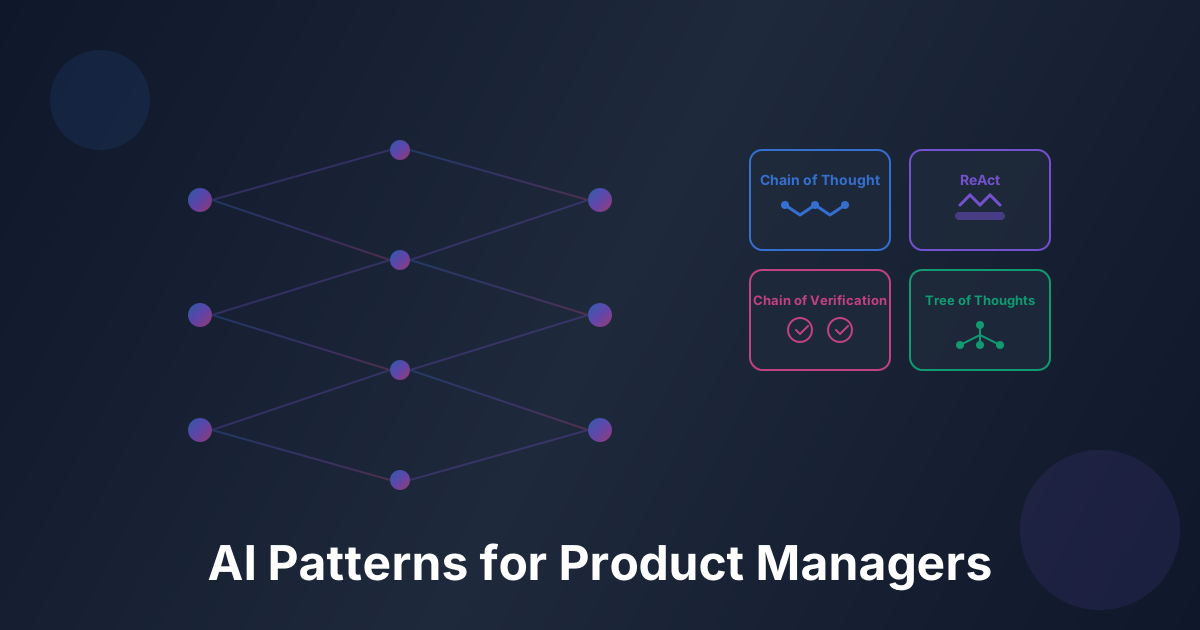
Unlocking AI Potential: LLM Patterns for Product Managers and Builders
Learn the essential LLM interaction patterns—from Chain of Thought to Chain of Verification—that help product managers and builders get smarter, more reliable results from AI.

MoSCoW Prioritization: The Complete Guide for Product Managers
Learn how to use the MoSCoW method to prioritize product features and requirements effectively. Includes examples, templates, and best practices.