Unlocking AI Potential: LLM Patterns for Product Managers and Builders
Learn the essential LLM interaction patterns—from Chain of Thought to Chain of Verification—that help product managers and builders get smarter, more reliable results from AI.
Product Leader Academy
PM Education
Why PMs Need to Understand LLM Patterns
As a product manager or builder, you're probably already using AI—whether it's ChatGPT for quick research, Claude for drafting docs, or coding assistants for prototyping. But are you getting the most out of these tools?
The difference between a generic AI response and a truly useful one often comes down to how you interact with the model. Researchers and practitioners have developed specific patterns—think of them as interaction recipes—that dramatically improve accuracy, reasoning, and reliability.
Understanding these patterns isn't about becoming an AI engineer. It's about using AI smarter so you can move faster, think clearer, and build better products.
The Core Patterns Every PM Should Know
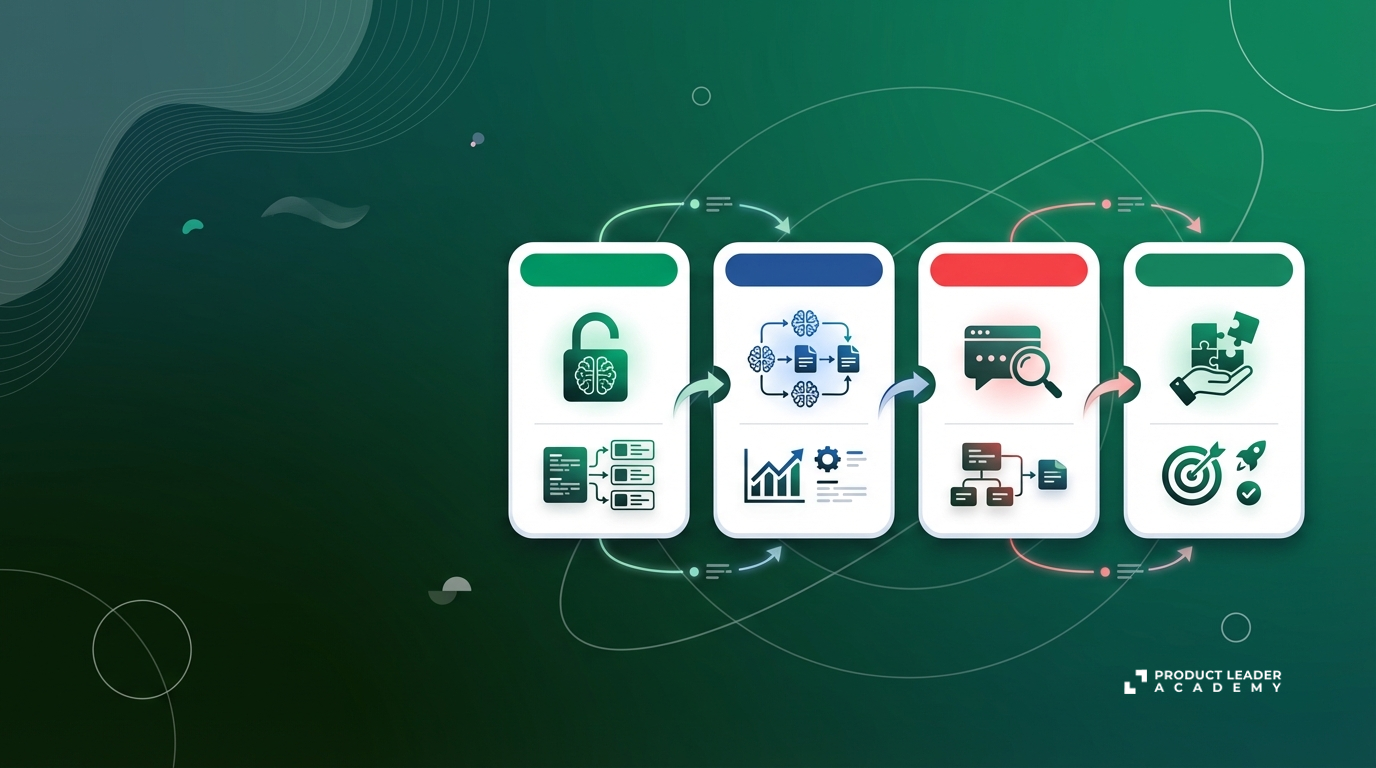
1. Chain of Thought (CoT): "Show Your Work"
What it does: Encourages the model to break down reasoning step by step before giving a final answer.
When to use it: Complex analysis, strategic planning, math problems, any scenario where jumping to conclusions is risky.
PM Example:
"I'm evaluating whether to build feature X. Walk me through the analysis step by step: market need, competitive landscape, engineering effort, revenue potential, and strategic fit. Show your reasoning at each step before giving a recommendation."
Why it works: LLMs often make errors when they rush to an answer. Forcing intermediate steps surfaces assumptions and catches logical gaps.
2. Chain of Verification (CoVe): Fact-Check Before You Ship
What it does: A multi-stage process where the model drafts a response, creates verification questions, answers them independently, then revises.
When to use it: Fact-heavy content, competitive analysis, user research summaries, anything where accuracy matters.
PM Example:
"Draft a competitive analysis of our three main competitors. Then list 5 verification questions that would fact-check your claims. Answer each question independently. Finally, revise your analysis based only on verified facts."
Why it works: LLMs hallucinate—confidently stating incorrect information. CoVe forces verification without letting the draft influence the fact-checking. Meta AI research showed CoVe reduced factual errors by up to 60%.
Pro tip: This is essential for external-facing content. Don't let AI-generated competitive intelligence go to stakeholders without verification.
3. ReAct (Reason + Act): The Research Assistant Pattern
What it does: Interleaves reasoning with actions—searching, calculating, looking up data—then reasons again based on results.
When to use it: Multi-hop questions, real-time research, building AI-powered features, anything requiring external information.
PM Example:
"What are the top 5 feature requests from our enterprise customers this quarter? Search our support tickets and CRM notes, identify patterns, then synthesize the findings with customer impact scores."
(In a ReAct-enabled system, the model would actually query your databases as part of this process.)
Why it works: Separates thinking from data retrieval. The model knows what it doesn't know and actively seeks answers rather than hallucinating.
4. Tree of Thoughts (ToT): Explore Multiple Paths
What it does: Explores multiple reasoning approaches simultaneously, evaluates each, and selects the best path forward.
When to use it: Strategic decisions, brainstorming, complex trade-offs, scenarios with multiple valid approaches.
PM Example:
"We're considering three go-to-market strategies: product-led growth, sales-led, or hybrid. For each approach, outline the first 90 days, required resources, key risks, and expected outcomes. Evaluate which strategy best fits our constraints."
Why it works: Unlike CoT's single path, ToT acknowledges that problems often have multiple valid solutions. It forces systematic evaluation before commitment.
5. Prompt Chaining: Break Big Problems into Steps
What it does: Decomposes complex tasks into sequential subtasks, where output from step N becomes input for step N+1.
When to use it: Document processing, ETL workflows, user story generation from research, any multi-stage workflow.
PM Example:
Step 1: "Extract all pain points mentioned in these 10 user interview transcripts."
Step 2: "Group these pain points by theme and frequency."
Step 3: "For each theme, write a user story following the format: As a [persona], I want [goal] so that [benefit]."
Why it works: Complex prompts often confuse models. Chaining maintains clarity and lets you inspect intermediate outputs for quality.
Practical Applications for Product Teams
User Research Analysis
Traditional approach: Read 20 interview transcripts, manually tag themes, synthesize findings (hours of work).
AI-powered approach:
- Chain: Extract quotes → Tag themes → Summarize patterns → Generate insights
- CoVe: Verify theme accuracy against raw quotes
- ToT: Compare multiple interpretation frameworks
Time saved: 70-80% with comparable (or better) rigor.
Competitive Intelligence
Challenge: Staying current on competitor moves without spending hours reading press releases and changelogs.
Pattern: ReAct + CoVe
- ReAct: Search latest news → Summarize updates → Cross-reference with your positioning
- CoVe: Verify claims about competitor features before including in analysis
PRD Writing
Challenge: Translating strategic thinking into detailed requirements.
Pattern: CoT + Prompt Chaining
- CoT: Walk through user journey step by step
- Chain: Generate user stories → Define acceptance criteria → Identify edge cases → Create test scenarios
The result: More thorough PRDs with fewer gaps.
Prioritization & Roadmapping
Challenge: Evaluating trade-offs across multiple dimensions (user value, effort, strategic fit, risk).
Pattern: ToT + CoT
- ToT: Explore different prioritization frameworks (RICE, Kano, custom)
- CoT: For each framework, reason through scoring systematically
Benefit: Exposes biases in your prioritization process and surfaces considerations you might have missed.
Quick Reference: When to Use Which Pattern
| Goal | Pattern | Why |
|---|---|---|
| Strategic analysis | CoT or ToT | Exposes assumptions, evaluates options |
| Fact-heavy content | CoVe | Reduces hallucinations, improves accuracy |
| Research tasks | ReAct | Combines reasoning with data retrieval |
| Document processing | Prompt Chaining | Maintains quality across complex workflows |
| Brainstorming | ToT | Explores creative solutions systematically |
| Code/technical specs | ReAct + CoT | Reasoning + tool use for precise outputs |
Implementation Tips for PMs
Start Simple
Don't over-engineer. Begin with zero-shot CoT—just add "think step by step" to your prompts. You'll immediately see better reasoning.
Compose Patterns
Real value comes from combining patterns:
- CoT + ReAct: Reason through each step, using tools when needed
- Prompt Chaining + CoVe: Break into steps, verify at each checkpoint
- ToT + CoT: Explore multiple paths, each with rigorous reasoning
Know When NOT to Use
These patterns add latency and cost. Don't use CoVe for casual brainstorming or quick ideation. Reserve verification for high-stakes outputs.
Build a Pattern Library
Create templates for your most common tasks:
- User interview synthesis prompt
- Competitive analysis workflow
- PRD generation chain
- Prioritization reasoning framework
The Bigger Picture: AI-Native Product Management
Understanding these patterns isn't just about using ChatGPT better. It's about how product management itself is evolving:
-
Research acceleration: Patterns like ReAct and Chaining let PMs process 10x more input without losing rigor.
-
Better stakeholder communication: CoT-style reasoning helps you articulate your thinking more clearly to engineers and executives.
-
AI-powered products: If you're building AI features, these are the same patterns your products should implement.
-
Decision quality: ToT and CoVe reduce cognitive biases by forcing systematic evaluation.
Getting Started Today
This week: Add "think step by step" to one complex analysis prompt. Notice the difference in output quality.
This month: Implement CoVe for one external-facing deliverable (competitive analysis, user research summary, or strategy doc).
This quarter: Build a library of chained prompts for your most common PM workflows.
Final Thought
AI won't replace product managers. But PMs who understand how to work with AI—using patterns like CoT, CoVe, and ReAct—will have a massive advantage over those who don't.
The patterns in this post aren't theoretical research. They're practical tools that working PMs are already using to move faster, think more clearly, and build better products.
The question isn't whether to adopt these patterns. It's how quickly you can start using them.
Ready to master AI-powered product management? Join Product Leader Academy for hands-on training, templates, and a community of PMs pushing the boundaries of what's possible.
Tags
Related Articles

Unlocking AI Potential: LLM Patterns for Product Managers and Builders
Learn the essential LLM interaction patterns—from Chain of Thought to Chain of Verification—that help product managers and builders get smarter, more reliable results from AI.

MoSCoW Prioritization: The Complete Guide for Product Managers
Learn how to use the MoSCoW method to prioritize product features and requirements effectively. Includes examples, templates, and best practices.

RICE Scoring: A Data-Driven Approach to Product Prioritization
Master the RICE scoring framework used by Intercom and top product teams. Learn to calculate Reach, Impact, Confidence, and Effort for better prioritization.