Value vs. Effort Matrix: The Quick Prioritization Guide for Product Teams
Learn to use the 2x2 Value vs. Effort matrix for rapid feature prioritization. Identify quick wins, strategic investments, and time sinks.

Product Leader Academy
PM Education
What is the Value vs. Effort Matrix?
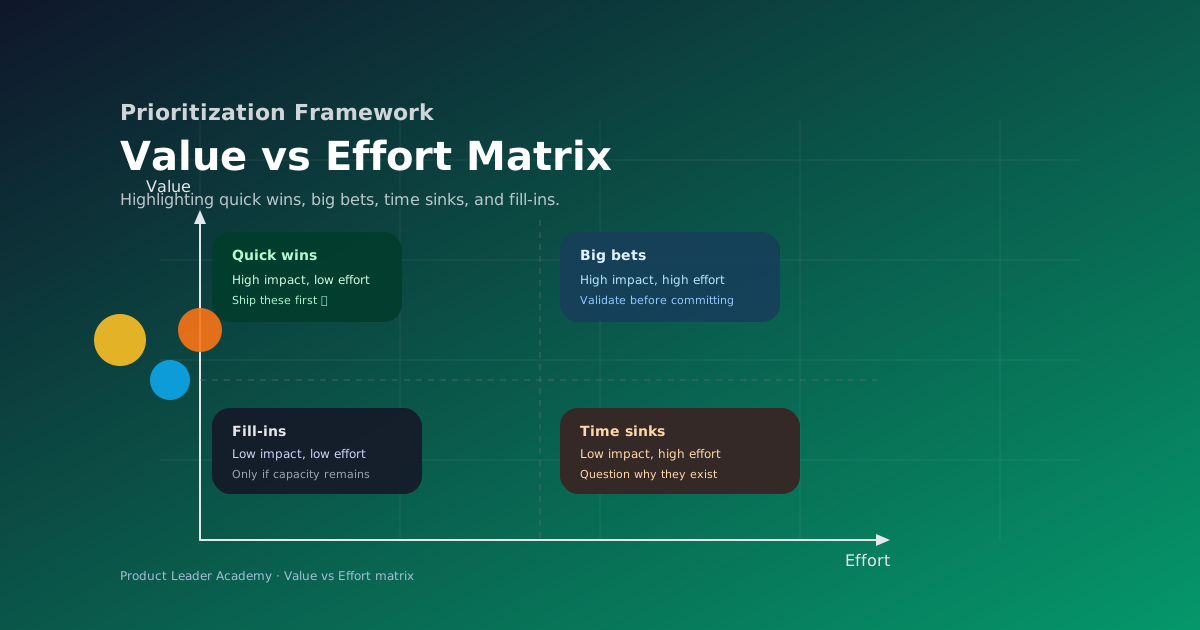
The Value vs. Effort Matrix (also called Impact vs. Effort or the 2x2 Priority Matrix) is the simplest prioritization framework in a product manager's toolkit. It plots initiatives on two axes:
- Value (Y-axis): The expected benefit—revenue impact, user satisfaction, strategic alignment, or any metric that matters to your business
- Effort (X-axis): The total cost—engineering time, design work, operational complexity, and risk
The result is four quadrants that instantly clarify where to focus.
The Four Quadrants
Quick Wins (High Value, Low Effort)
Do these first. Maximum return for minimum investment.
- Small UX improvements that fix major friction
- Configuration changes that unlock revenue
- Copy updates that improve conversion
- Bug fixes affecting many users
Example: Adding auto-save to a document editor. Low engineering effort, prevents major user frustration.
Strategic Bets (High Value, High Effort)
Plan and invest carefully. These are your big product bets that require significant resources but deliver outsized returns.
- New product lines or major features
- Platform migrations
- Market expansion initiatives
- Core architecture improvements
Example: Rebuilding your mobile app from scratch to improve performance 5x.
Fill-Ins (Low Value, Low Effort)
Do when convenient. Nice-to-have improvements that don't justify dedicated planning.
- Minor UI polish
- Small feature requests from individual users
- Internal tool improvements
- Documentation updates
Example: Adding keyboard shortcuts for power users. Low effort, modest value.
Time Sinks (Low Value, High Effort)
Avoid or eliminate. These drain resources without meaningful return. The most dangerous items in your backlog.
- Vanity features
- Over-engineered solutions to minor problems
- Requests from a single stakeholder without data support
- "Nice to have" projects that keep growing in scope
Example: Building a custom analytics dashboard when existing tools work fine.
How to Run a Value vs. Effort Session
Step 1: Prepare the Candidate List
Gather 10-30 initiatives to evaluate. Sources:
- Product backlog
- Customer feedback themes
- Stakeholder requests
- Technical debt items
- OKR-aligned ideas
Step 2: Define Your Axes
Value criteria (pick what matters most for your context):
- Revenue impact
- User retention improvement
- Strategic alignment
- Customer satisfaction score
- Market differentiation
Effort criteria (be comprehensive):
- Engineering person-weeks
- Design complexity
- Dependencies on other teams
- Risk/uncertainty
- Ongoing maintenance cost
Step 3: Calibrate with Examples
Before scoring, align the team on what "high" and "low" mean:
High Value example: "Feature X would increase conversion by 15% based on A/B test data" Low Value example: "Feature Y was requested by 2 users in the last quarter" High Effort example: "Requires 3 engineers for 6 weeks plus a new infrastructure component" Low Effort example: "One engineer, one sprint, no new dependencies"
Step 4: Plot Each Item
For each initiative:
- Discuss and agree on relative Value (High/Medium/Low)
- Get engineering input on Effort (High/Medium/Low)
- Place on the matrix
Pro tip: Use sticky notes on a whiteboard or a digital tool like Miro. Physical movement helps drive discussion.
Step 5: Decide and Commit
- Quick Wins: Schedule in next sprint
- Strategic Bets: Add to quarterly roadmap with dedicated resources
- Fill-Ins: Add to backlog, pick up in slack time
- Time Sinks: Explicitly remove from backlog and document why
Making It More Rigorous
Adding a Scoring Scale
For teams that want more precision, use a 1-5 scale:
| Score | Value | Effort |
|---|---|---|
| 5 | Revenue-critical, affects all users | Trivial, < 1 day |
| 4 | Major improvement, 50%+ users | Small, 1-3 days |
| 3 | Moderate improvement, significant segment | Medium, 1-2 weeks |
| 2 | Minor improvement, small segment | Large, 2-6 weeks |
| 1 | Marginal, few users notice | Massive, 6+ weeks |
Priority Score = Value / Effort
Rank by priority score, then validate the ranking makes intuitive sense.
Weighted Value
If you need to factor in multiple dimensions of value:
Weighted Value = (0.4 × Revenue Impact) + (0.3 × User Satisfaction) + (0.3 × Strategic Fit)
Adjust weights to match your current company priorities.
Value vs. Effort in Practice
Sprint Planning
Use the matrix at the start of each sprint:
- Pull top items from backlog
- Quick-plot on the matrix
- Fill the sprint with Quick Wins first
- Add one Strategic Bet if capacity allows
- Sprinkle Fill-Ins if there's remaining capacity
Quarterly Roadmapping
At the quarter level, the matrix helps balance the portfolio:
- 60% Quick Wins + Fill-Ins (predictable delivery)
- 30% Strategic Bets (growth investment)
- 10% Buffer for emergencies
Stakeholder Negotiations
When a stakeholder pushes a pet project, plot it on the matrix together. The visual makes it clear when something falls in the Time Sink quadrant—without confrontation.
Best Practices
1. Include Engineering Early
Effort estimates without engineering input are guesses. Include a tech lead in every prioritization session.
2. Challenge "High Value" Claims
Ask: "What data supports this value estimate?" Gut feel is okay for Quick Wins, but Strategic Bets need evidence.
3. Revisit Effort Estimates
Initial estimates are often wrong. After completing a few items, recalibrate your understanding of effort.
4. Don't Over-Index on Quick Wins
A backlog full of Quick Wins feels productive but may neglect the Strategic Bets that drive long-term growth. Balance is essential.
5. Make Time Sinks Visible
Explicitly label and remove Time Sinks. Teams often keep them in the backlog "just in case," which creates noise and false optionality.
Common Mistakes
- Effort amnesia — Forgetting to include design, QA, documentation, and deployment in effort estimates
- Value inflation — Everything becomes "high value" without data
- Ignoring dependencies — A Quick Win that requires another team's work isn't quick
- Static matrix — Priorities change; re-evaluate monthly
- Analysis paralysis — The matrix is for speed; don't spend hours debating placement
Value vs. Effort vs. Other Frameworks
| Framework | Speed | Rigor | Best For |
|---|---|---|---|
| Value vs. Effort | Fast (30 min) | Low-Medium | Sprint planning, quick decisions |
| RICE | Medium (2 hrs) | High | Quarterly roadmap |
| MoSCoW | Fast (1 hr) | Medium | Requirements triage |
| Kano | Slow (weeks) | High | Feature strategy |
| Weighted Scoring | Medium (2 hrs) | High | Complex multi-criteria decisions |
Conclusion
The Value vs. Effort Matrix is the Swiss Army knife of prioritization. It won't give you the rigor of RICE or the customer insight of Kano, but it will give you a clear, defensible prioritization in 30 minutes.
Use it when you need speed. Combine it with more rigorous frameworks when stakes are high. And always—always—put Time Sinks in the graveyard where they belong.
Want to practice prioritization with real product scenarios? Join Product Leader Academy for hands-on frameworks training and peer feedback.
Tags
Related Articles

The Scope Expansion Audit: How PMs Map and Tame Scope Creep
Learn how to use the Scope Expansion Audit (SEA) to map dependencies, evaluate value-to-complexity, and manage scope creep without burning developer bridges.

MoSCoW Prioritization: The Complete Guide for Product Managers
Learn how to use the MoSCoW method to prioritize product features and requirements effectively. Includes examples, templates, and best practices.

RICE Scoring: A Data-Driven Approach to Product Prioritization
Master the RICE scoring framework used by Intercom and top product teams. Learn to calculate Reach, Impact, Confidence, and Effort for better prioritization.